Japa Meditation7 min read•Published: 2026-03-15

The Sacred Science of 108 Beads in Japa Mala: Vedic Mathematics & Spiritual Significance

Why does a traditional Hindu rosary consist of exactly 108 beads? Explore the cosmic, anatomical, and mathematical foundations of 108 in Sanatana Dharma.

BhaktiAI Vedic Research Board
Sanatana Dharma Scholars & Practitioners • Updated 2026-10-28
1450 words
The Sacred Science of 108 Beads in Japa Mala: Vedic Mathematics & Spiritual Significance
BhaktiAI Sacred Studies SeriesSanatana Dharma Canonical Research

1. The Universal Mystery of the Number 108

In Sanatana Dharma, the number 108 is far more than a cultural convention; it is regarded as a sacred mathematical constant connecting the human microcosm with the cosmic macrocosm. When a devotee holds a Rudraksha or Tulsi mala with 108 beads, every single revolution through the fingers represents a sacred journey through cosmic geometry and inner biological rhythm.

Ancient Vedic rishis (seers) understood that consciousness is intimately entwined with the movement of celestial bodies and the pranic channels of the human body. Chanting a mantra 108 times brings the subtle energy body into harmonic resonance with the cosmos.

Sacred Verse & Shloka
Isha Upanishad (Shanti Mantra)

ॐ पूर्णमदः पूर्णमिदं पूर्णात्पूर्णमुदच्यते । पूर्णस्य पूर्णमादाय पूर्णमेવાવશિષ્યતે ॥

"Om Purnamadah Purnamidam Purnat Purnam Udachyate | Purnasya Purnam Adaya Purnam Evavashishyate ||"

Spiritual Meaning: That is whole, this is whole; from the whole, the whole becomes manifest. Taking away the whole from the whole, the whole alone remains.

2. The Astronomical Harmony of the Cosmos

Remarkably, modern astrophysics confirms the precise mathematical ratios that Vedic astronomers documented millennia ago in texts like the Surya Siddhanta:

First, the distance between the Earth and the Sun is approximately 108 times the Sun's diameter (about 107.5 to 108.2 depending on orbital perihelion).

Second, the distance between the Earth and the Moon is approximately 108 times the Moon's diameter (about 108 to 110 times).

Third, the Sun's diameter is roughly 108 times the diameter of the Earth (109.2 times).

These celestial alignments mean that from our vantage point on Earth, the Sun and the Moon appear to be the exact same angular size in the sky — making solar and lunar eclipses possible. When you chant a mantra 108 times, you symbolically traverse the cosmic distance connecting Earth, Moon, and Sun.
Key Spiritual Insights
  • Earth to Sun distance ≈ 108 × Sun's diameter
  • Earth to Moon distance ≈ 108 × Moon's diameter
  • Sun's diameter ≈ 108 × Earth's diameter
  • Cosmic geometry reflects the unity of macrocosm and microcosm

3. Vedic Astrology & The 108 Cosmic Energy Divisions

In Jyotisha (Vedic astrology), the zodiac is divided into 12 Rashis (zodiac signs) and 27 Nakshatras (lunar constellations or asterisms).

Each Nakshatra is further divided into 4 Padas (quarters or steps), representing the four purusharthas: Dharma (duty), Artha (wealth), Kama (desire), and Moksha (liberation).

When we multiply 27 Nakshatras by 4 Padas, we get exactly 108 cosmic steps (27 × 4 = 108). Furthermore, dividing the 108 padas among the 12 signs gives 9 padas per sign (12 × 9 = 108).

Thus, completing 108 repetitions of a divine name blesses and harmonizes all 108 planetary positions and cosmic vibrations influencing human destiny.

4. The Subtle Anatomy: 108 Energy Nadis & Heart Chakra

According to Ayurvedic medicine and yogic physiology, the human body contains an intricate network of 72,000 Nadis (subtle energy currents).

All prana (life-force) originates from the Hridaya (spiritual heart center) or Anahata Chakra. Out of all the energy channels, exactly 108 principal nadis converge at the sacred heart chakra before radiating through the nervous system.

One of these nadis — the Sushumna Nadi — flows upward from the base of the spine directly to the Sahasrara (crown chakra). Chanting with full awareness 108 times purifies every one of these heart nadis, opening the gateway to samadhi and deep meditative stillness.

5. The Guru Bead (Meru) and Chanting Etiquette

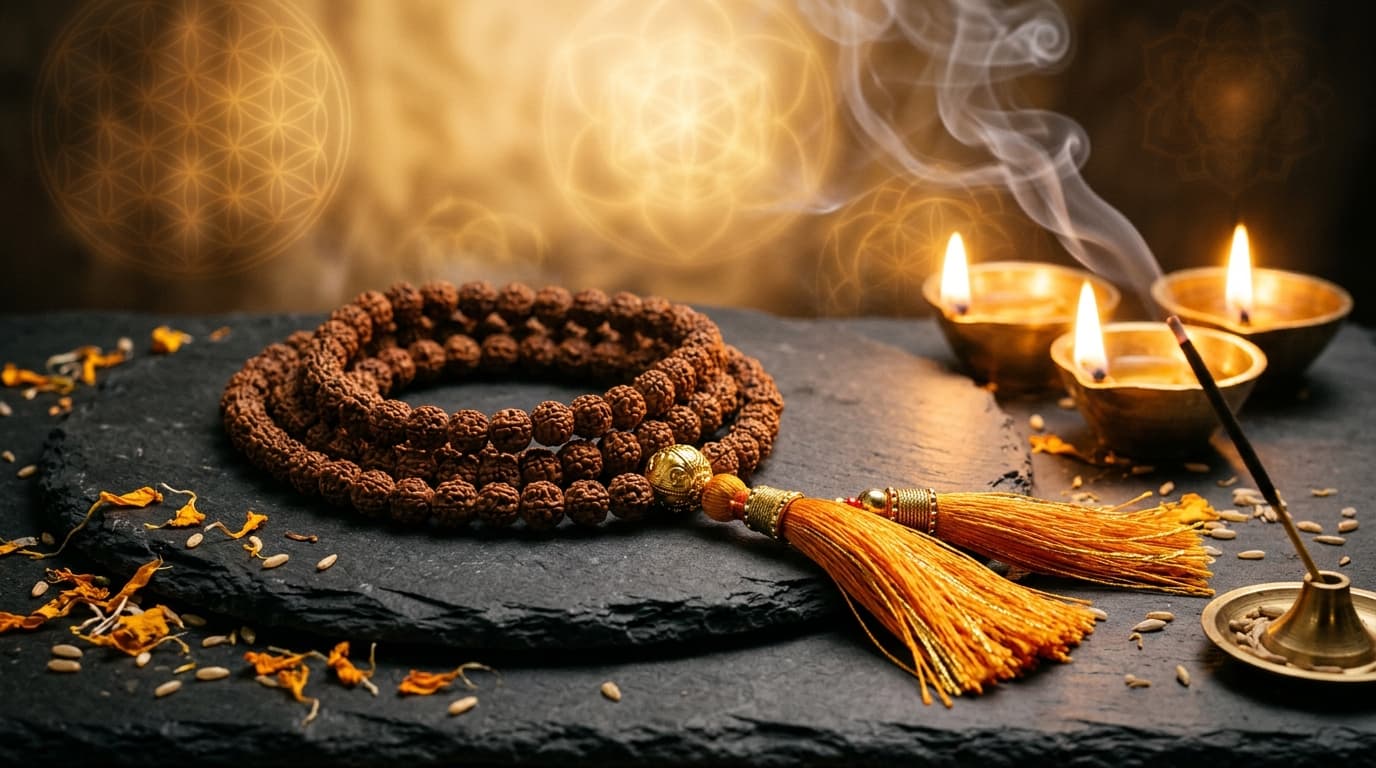
Every genuine 108-bead Japa Mala includes a 109th bead known as the Meru, Guru Bead, or Sumeru. This bead sits atop the tassel and is intentionally larger than the rest.

The Meru bead represents the Supreme Divine and the Guru. In authentic Vedic japa tradition, the practitioner never crosses the Meru bead. When you reach bead 108, you pause in reverence, gently rotate the mala 180 degrees using your thumb and middle finger, and proceed in the reverse direction for the next round.

This physical pause prevents mechanical, unconscious chanting and maintains mindful awareness of the Guru's grace.

Key Spiritual Insights
  • Never cross over the Meru bead during japa
  • Always turn the mala in the reverse direction upon completion
  • Use the thumb and middle finger to roll beads; avoid pointing with the index finger (ego)
  • Maintain upright posture and inward gaze during meditation
Daily Sacred Darshan

Experience High-Resolution 4K Wallpapers

Immerse your daily life in sacred geometry and divine presence with verified 4K mobile wallpapers.

Explore Darshan Gallery
Devotional Questions & Answers

Frequently Asked Questions

Q:What should I do if I cannot complete all 108 chants in one sitting?

While completing the full 108 is traditional, consistency matters far more than volume. Sincere chanting of 27 or 54 times with deep devotion is spiritually superior to mechanical chanting. You can also break your practice into morning and evening sessions.

Q:Why is the index finger avoided while holding the Japa Mala?

In mudra science, the index finger represents the Ahankara (ego / individuality), while the thumb represents Brahman (Supreme Reality). Using the middle finger (representing Sattva / purity) alongside the thumb keeps the practice free from egoistic impulses.

Q:Can I use digital mala apps like BhaktiAI for valid 108 japa?

Yes. Authentic traditional masters emphasize that Bhava (inner devotional absorption) and concentrated attention are paramount. A digital mala counter provides structured accountability, calming temple bells, and haptic feedback for modern devotees on the go.

BhaktiAI Vedic Research Board

Sanatana Dharma Scholars & Practitioners

Composed of Sanskrit linguists and devotional practitioners dedicated to preserving classical Vedic knowledge and sacred iconography.

Deepen Your Sadhana

Related Canonical Studies